In K-pop, a comeback is an established artist’s new music release and the promotion around it. It does not necessarily mean a return after a long hiatus or a reunion. Teasers, music videos, and performances may belong to the same release campaign.[1][2][5]
That distinction explains a confusing headline: a group can finish promoting one release, announce another, and call it a comeback. You have not necessarily missed a breakup or a reunion.
For a new listener, the useful questions are simple: What is coming out? When can you hear it? Which videos help you enjoy the songs?
This guide explains comeback terminology and the release process. Its timeline is a documented past example, not a live calendar of upcoming releases.
Why is it called a comeback in K-pop?
K-pop uses “comeback” to connect a release with the activity around it. New songs are part of the picture; performances and promotional appearances are another part. Mashable’s K-pop glossary describes the term as releasing and promoting new music, while Soompi’s glossary notes that a comeback stage does not require a minimum waiting period after the previous promotion.[1][2]
A debut is an artist’s introduction. A comeback follows an existing debut. An established group member’s first solo release may still be announced as a solo debut, so follow how the artist labels that particular project. The term “comeback” alone does not tell you how long the artist has been away, how large the release is, or how successful it will be.
You may also see fans talk about an “era.” That usually refers to a period associated with a particular release and its look or concept. Treat it as a way of discussing the music and performances, not a separate kind of album.[1]
K-pop comeback stages: a real TXT timeline
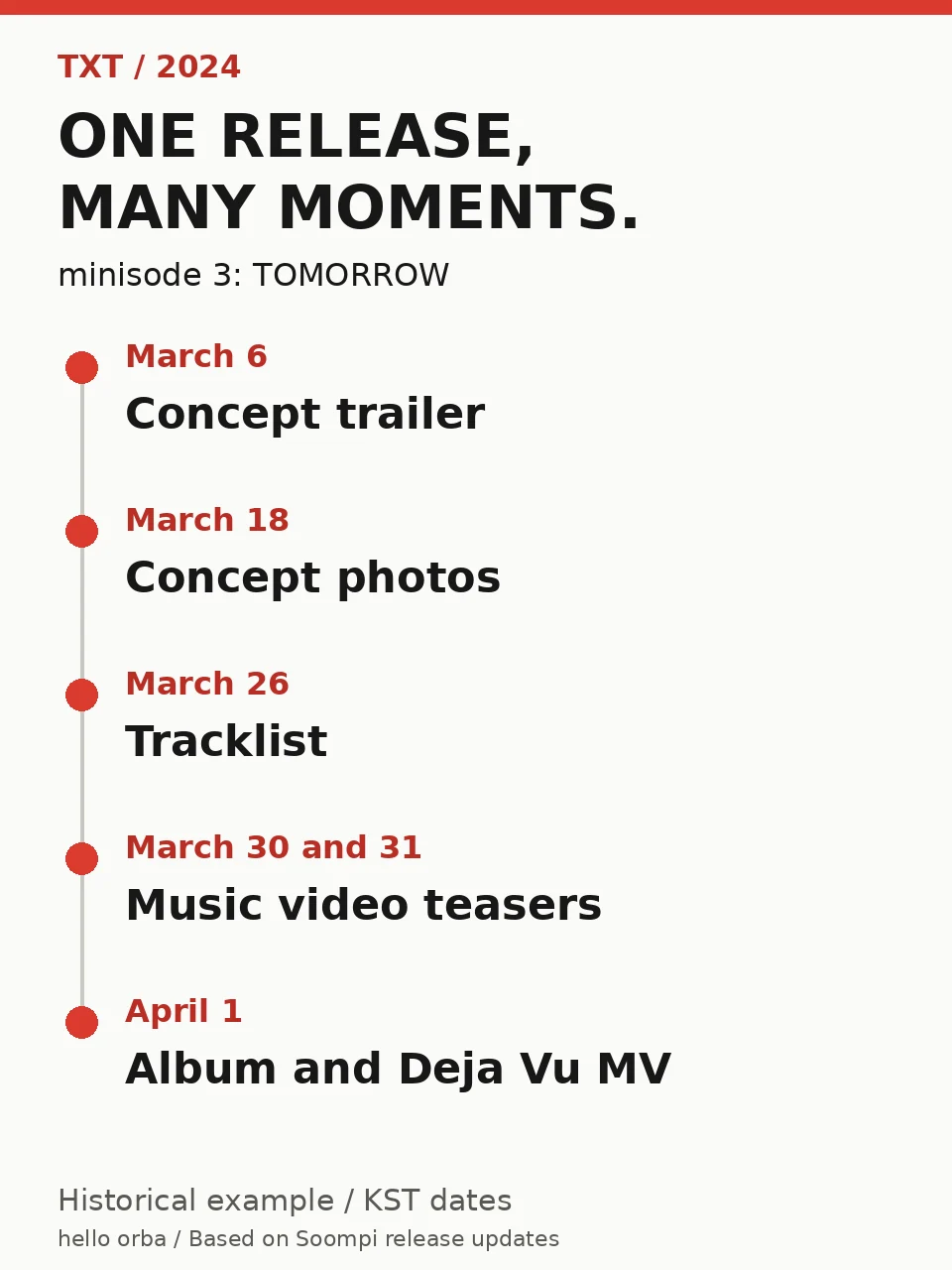
A release can arrive through several announcements rather than one video. A useful historical example is TOMORROW X TOGETHER’s minisode 3: TOMORROW. Soompi’s rolling coverage records a concept trailer, a promotion schedule, concept photos, a tracklist, music previews, video teasers, and the eventual release.[5]
| Part of the rollout | What TXT released in 2024 (KST dates) | What a new listener can take from it |
|---|---|---|
| Concept trailer | A trailer on March 6 | An introduction to the release’s visual world |
| Concept photos | The first set on March 18 | A look at the styling and imagery |
| Tracklist | Song information on March 26 | A way to distinguish the album from its individual songs |
| Music video teasers | Teasers on March 30 and 31 | A short preview before the full video |
| Release | The mini album and “Deja Vu” music video on April 1 | The point when listeners could hear the release rather than just previews |
Those dates are a past example, not an upcoming release calendar. They come from Soompi’s updates for that specific campaign.[5]
Use the example to recognize the labels, not to predict every artist’s schedule. A trailer explains less about the complete songs than an album preview does. A concept photograph shows styling; it is not evidence that every track will sound a particular way.
For your first comeback, save the artist’s own release announcement or schedule. Read the stated time zone carefully. The date where you live may differ from the date in Korea. You can follow the full sequence if the previews interest you, or return when the music is out.
How to read a comeback schedule without mixing up the dates
Read the labels beside the dates before adding anything to your calendar. A concept-photo date is not the date the whole album becomes available. A preorder opening is a shopping milestone, not proof that you can already stream the songs.
Make a note of the full release name, the release date and time, and the time zone. Keep the original announcement as a reference rather than relying only on a cropped image in a repost. If two posts appear to disagree, check whether they concern different items: a teaser, a music video, a digital release, or a physical product.
TXT’s release gives us a worked example. Soompi reported the mini album and title-track video arriving on April 1, 2024, at 6 p.m. KST.[5] Converting that historical instant produces these local times:
| Location | Local time for that specific release |
|---|---|
| Seoul | April 1, 2024, 6 p.m. KST |
| London | April 1, 2024, 10 a.m. BST |
| New York | April 1, 2024, 5 a.m. EDT |
| Los Angeles | April 1, 2024, 2 a.m. PDT |
These are calculated time-zone conversions for April 1, 2024, not a permanent conversion table. Daylight-saving rules can change the relationship between Korean time and your local clock. Convert the actual date in the announcement you are following.
If a schedule uses the 24-hour clock, check it before setting an alarm. In this example, 18:00 means 6 p.m., not 6 a.m. The useful habit is to keep the time zone attached to the time rather than saving an isolated number.
You also do not need to wake up for every scheduled upload. If a post is simply a photo or teaser release, you can decide to view it later. Treat application windows and ticket or recording deadlines separately: those require the exact event’s current rules.
Title track vs. B-side: what you are listening to
In K-pop, “title track” usually means the main song being promoted from a release. It does not mean you should assume that the song shares the album’s name.[2]
TXT’s example makes the distinction easy to see: the mini album was called minisode 3: TOMORROW, while its title track was “Deja Vu.”[5]
Fans also use “B-side” for an album song outside its main title-track promotion. That is a useful listening distinction, not a judgment that the song is less worth hearing. Start with the promoted song if you need an entry point, then listen to the rest of the release before deciding which track you prefer.
A label such as “mini album” identifies a release format. You do not need to memorize a universal track count to follow the announcement. Read that release’s tracklist instead.
Single, mini album, full album, and repackage
These labels answer a different question from “comeback.” They describe what is being released, while comeback describes the return with new music and its promotion.[1][2]
| Label in an announcement | What to check |
|---|---|
| Single or single album | Whether the announcement refers to an individual song or a release package, and which tracks it includes |
| Mini album or EP | The tracklist and the actual music, rather than an assumed fixed number of songs |
| Full album | The complete tracklist and which song or songs the artist is promoting |
| Repackage | Which tracks come from the earlier album and which material has been added |
Soompi’s glossary describes a repackaged album as a re-release with a new title track and other material.[2] That is useful context if a familiar album name appears again. It does not mean that every newly packaged edition contains new music.
If you choose to buy a physical edition, compare its tracklist with its listed contents. Different covers, photocards, and package names should not be your only evidence that the music is different. Check what the seller and artist actually say that edition contains before ordering.
This also helps you separate the music from collecting. You can be interested in the album’s songs without deciding which physical version you want. Following a comeback and collecting its merchandise are different activities.
What is a comeback stage in K-pop?
A comeback stage is a performance associated with an artist’s new release. In music-show usage, it refers to the artist’s first performance promoting that release on the program. More than one show can present its own comeback stage, so the label does not always mean you have found the first performance anywhere.[2]
Korean music shows are television programs where artists perform and promote music. Examples include Music Bank, M Countdown, and Inkigayo. Their performances give listeners another way to encounter a release beyond its music video.[1][2]
Watching a performance online is also different from attending its recording. An official CORTIS notice for a Music Bank recording on August 29, 2025, specified advance applications, eligibility requirements, identity checks, and restrictions on filming.[4]
That is an example of an event’s rules, not a standing admission guide for every artist. If you want to attend a future recording, read the current official notice for that exact event before making plans or buying anything.
Music video, dance practice, performance video, or fancam?
When a search returns several videos for the same song, choose according to what you want to see rather than treating every upload as required viewing.
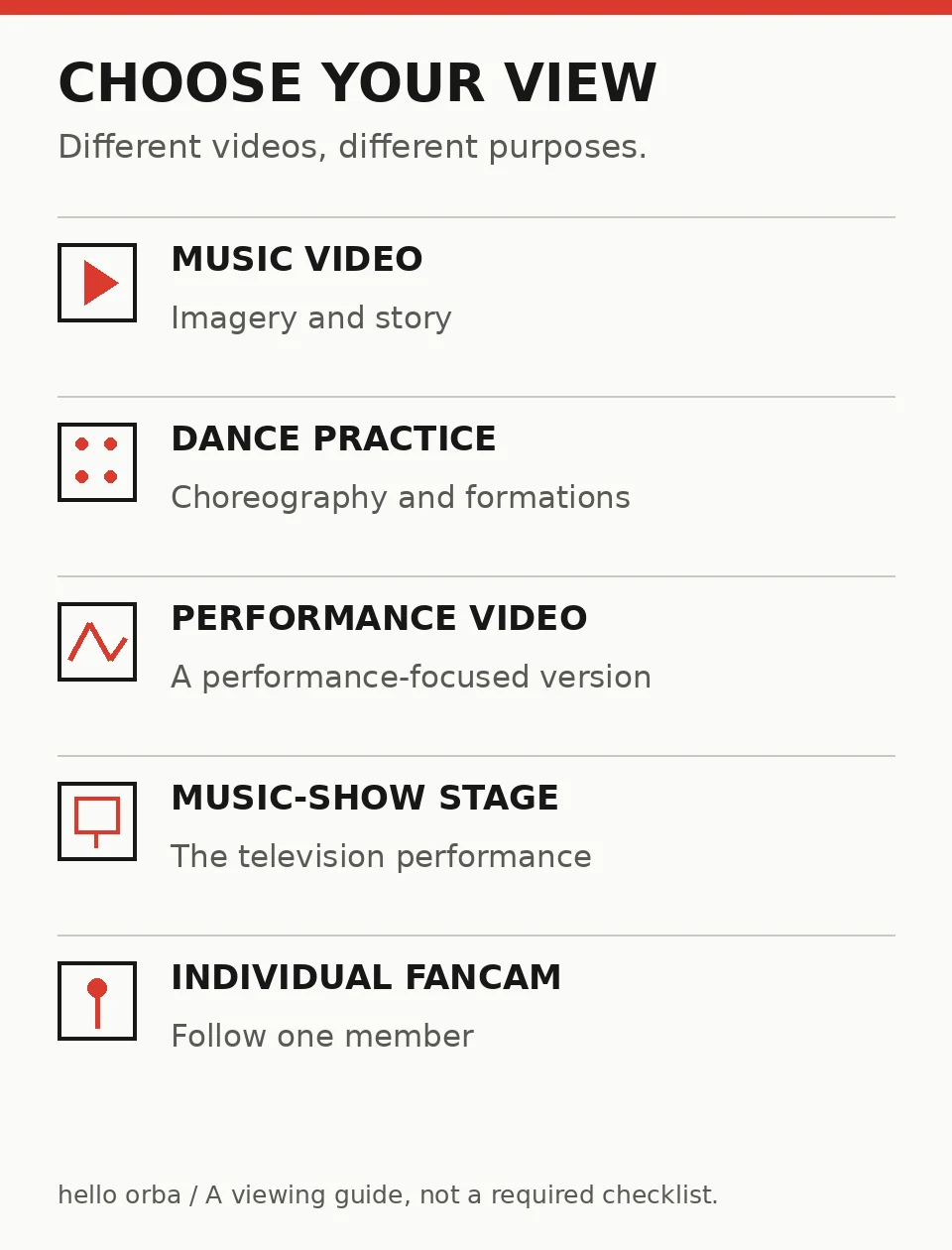
| Video label | A useful reason to choose it |
|---|---|
| Official music video or MV | You want the song’s produced visual presentation, including its imagery or story |
| Dance practice | You want to look more closely at choreography and group formations |
| Performance video | You want a performance-focused presentation; read the title and description to understand the particular version |
| Music-show stage | You want the performance prepared for that television program |
| Individual fancam | You want to follow one member through the performance rather than the program’s changing camera shots |
Mashable describes fancams as videos that track an individual performer and notes that music shows publish official fancams as well as fans making their own.[1] A fancam is therefore not automatically an unofficial upload, and an official stage is not the only official performance-related video you might find.
For a first watch, a full-group video makes it easier to see how the performance works as a whole. Move to an individual fancam if a particular performer or part of the choreography catches your attention. This is a viewing suggestion, not a rule about the correct order.
Check the publisher when the distinction matters. A fan edit can be enjoyable, but it should not replace an artist’s release notice or an organizer’s event announcement. Read what the uploader says about a video rather than assuming its title proves how the audio was recorded or edited.
How long does a comeback last?
Separate the release date from the promotion period. A song can become available at a stated time while the surrounding videos and performances continue afterward. In the TXT example, the teasers and other material also began before the release itself.[5]
Mashable’s glossary describes promotional periods lasting a few weeks and explains the phrase “goodbye stage” for a closing performance.[1] Use that as context for the terminology, not a fixed timetable that every artist must follow.
A goodbye stage for a release is not, by itself, an announcement that a group is breaking up. Similarly, a comeback-stage label does not tell you that the artist will appear on every music show or promote for a set number of weeks. Look for the actual schedule or announcement when you need those details.
What about music-show wins?
Music programs can award a weekly number-one trophy using a combination of factors that depends on the show. Mashable’s explanation includes sales, streaming, and voting among those factors.[1] This guide does not provide a universal points formula: use the program’s current rules if you want to understand a particular result.
A comeback announcement tells you that music is arriving, not that a trophy is guaranteed or that fans must join a voting campaign. You can follow the songs and performances without using weekly results as a checklist for enjoying them.
K-pop fan chants: what fans are shouting
The voices you hear between lines may be following a fan chant: an organized set of cheers, responses, or names timed to the performance.[1]
An official guide can make those parts much easier to recognize. For example, BTS’s official Weverse notice for “2.0” distinguishes passages for shouting from passages for singing along, using different colors.[3]
Look for “fan chant,” “cheering guide,” or the Korean term 응원법 alongside the song’s name on the artist’s official channels. Use the guide for that song rather than assuming a chant you learned for another release will fit.
You do not need to learn a chant before listening to the music. It is one way to join a performance, not a test you have to pass to become a fan.
A manageable way to follow your first comeback
You can follow one release closely without opening every notification. This suggested plan separates the information you need from the optional activities around it.
- Save the official release announcement. Keep the artist and release name with the date, time, and time zone. If you save a translated explanation, keep a link to the original notice too.
- Choose how you want to hear the music. The full music video is one starting point; the album itself is another. Check the artist’s published links rather than assuming that a teaser or a countdown page is the complete release.
- Listen beyond the promoted song if you are interested. A B-side may appeal to you even when the title track does not. Decide from the music rather than the order in which a track appears in the promotion.
- Pick a performance for a reason. Try a full-group stage for the whole presentation, a dance-practice video for choreography, or an individual fancam when you want to follow a member.
- Decide separately about participation. Learn a fan chant if you enjoy it. Read the current requirements before applying for a recording, joining a vote, or buying something for an event.
The distinction between enjoying a release and joining a promotional activity matters. Buying an album, applying for an event, and participating in a vote are separate decisions. This guide does not ask you to spend money, open voting accounts, or leave videos running.
If you do decide to participate, check the current organizer’s rules. A past fan guide or a different artist’s notice is not a reliable substitute for the event you are considering.
You can also ignore the release-day rush and discover the songs later. The schedule tells you when content arrives; it does not create a deadline for enjoying it.
K-pop comeback FAQ
Can an artist have a comeback with just a single?
Yes. A comeback is about new music and its promotion, not a requirement to release a full album. Soompi’s description of a comeback stage explicitly includes the promotion of a new title track or single.[2] Check the announcement to see what the release actually contains.
Can a solo artist have a comeback?
The term is not limited to groups. The useful distinction is whether this is an artist’s introduction or a subsequent release in that project. An established group member may still introduce a first solo project as a solo debut; do not assume that the group’s history makes every solo release a comeback.
How often do K-pop artists have comebacks?
The word does not set an annual release quota. There is also no minimum gap built into Soompi’s definition of a comeback stage.[2] Use the artist’s announcements rather than assuming a fixed number of releases per year or treating an unannounced date as overdue.
Are several physical album versions several comebacks?
Do not count package designs as separate comebacks by default. Read the release announcement and compare the actual tracklists. Different covers or listed inclusions do not, by themselves, tell you that the music or promotion is a separate release.
Is a comeback the same thing as a tour?
No. A comeback concerns releasing and promoting music.[1] A tour announcement concerns scheduled performances and their locations. Check the actual concert notice for ticketing details rather than assuming a comeback announcement includes a show you can attend.
What does KST mean on a comeback schedule?
KST means Korea Standard Time. Treat it as part of the stated release time, not as your own local clock. The historical TXT example above shows why: the same release was scheduled for the evening in Seoul and the early morning in New York. Convert the exact date you need rather than reusing a previous release’s local time.
Does a comeback mean the group broke up and reunited?
No. In K-pop, the term can simply mean an established artist is releasing and promoting new music. The headline alone does not establish a breakup, reunion, or long hiatus.[1][2]
Is a comeback stage a concert?
The phrase commonly refers to a performance promoting a new release on a music program. Do not read it as a concert-ticket announcement unless the organizer actually describes a concert.[2]
Do I have to buy an album or vote?
Neither is a requirement for understanding the music or following this guide. Specific events can have purchase or other eligibility conditions, so decide whether you want to join that activity only after reading its official notice.[4]
Where should I start if the schedule feels overwhelming?
Watch the full music video, then listen to the rest of the release if the song interests you. A performance video is a useful next choice when you want to see the choreography.